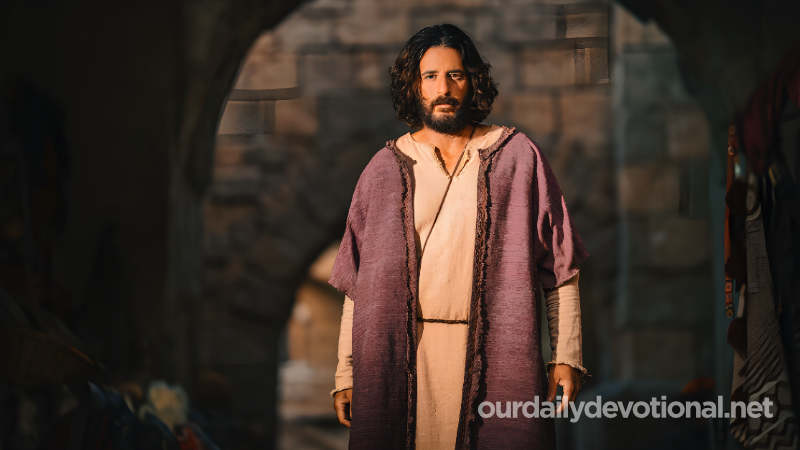
The second of the four Gospels, which does not necessarily tell us anything about the order of its writing. Its brevity (it is the shortest of the four) does not generally come from its concision, because it is rich in detail. A series of powerfully evocative scenes quickly unfold.
The chronological order is tighter than in Matthew and Luke. Mark gives us more the gestures and acts of Christ than his speeches. He only cites four parables, but recounts eighteen miracles, and only gives in full one of Jesus' longest speeches (Mark 13).
Mark insists on the power of Christ, the son of God (Mark 1:11; 5:7; 9:7; 14:61; also Mark 8:38; 12:1-11; 13:32; 14: 36), the triumphant savior. The two essential themes of this Gospel are the ministry in Galilee (Mark 1:14-9:51) and the last week in Jerusalem (Mark 11:1-16:8). These two sections are connected with a brief account about the intervening period (Mark 10:1-53).
Gospel Plan:
(a) Prelude to the Gospel of Jesus Christ: ministry of John the Baptist, baptism and temptation of Jesus (Mark 1:1-13).
(b) Beginning of the Galilean ministry: place, message, and vocation of the first four apostles, miracles in Capernaum and Galilee (Mark 1:14-45).
(c) Triumph of Christ over the opposition that was being articulated. Healing of the paralytic, Levi's banquet, discourse on fasting, controversy over the Sabbath (Mark 2:1-3:6).
(d) Despite growing opposition, the work of Christ is spreading among the multitudes; election of the twelve; replies to the Pharisees; intervention of the mother and brothers of Jesus; parables of the sower, of the seed that grows secretly, of the mustard seed; great miracles: the calming of the storm, the healing of the demon-possessed man of Gadarene, of the woman with an issue of blood, resurrection of Jairus' daughter; second rejection in Nazareth; mission of the twelve; Herod's investigation of Jesus and execution of John the Baptist; first multiplication of loaves; Jesus walking on the waters; Jesus' attack on the traditionalism of the Pharisees (Mark 3:7-7:23).
(e) Period of relative retirement corresponding to the later Galilean ministry: healing of the daughter of the Syrophoenician woman in the regions of Tire and Sidon; of a deaf in Decapolis; second multiplication of the loaves, refusal to give a sign to the Pharisees; warning to the disciples to beware of them; healing of a blind man near Bethsaida; visits to towns in the Caesarea de Philippi district; Peter's confession; announcement of the passion of Jesus; transfiguration; healing of a demon possessed; Jesus again predicts his death; return to Capernaum; recommendations to the disciples (Mark 7:24-9:50). This period is particularly detailed in Mark.
(f) In Perea; end of Christ's ministry: Pharisees' question about divorce; blessing of children; the rich young man; Jesus' response to the disciples; ascent to Jerusalem; third prediction of his death; request of James and John; restoration of sight to blind Bartimaeus (Mr. 10).
(g) The last week: triumphal entry into Jerusalem; curse against the fig tree; second purification of the Temple; question from the delegates of the Sanhedrin; parable of the vinedressers; leading questions from the Pharisees, Herodians, Sadducees and a scribe; Christ questions them in turn on the subject of David's son; brief accusation against the Pharisees and the scribes (cf. Mt. 23); the widow's offering; speech given on the Mount of Olives; betrayal of Judas and dinner in Bethany; brief description of the last afternoon with the disciples and institution of the Supper; the agony in Gethsemane; the arrest; the nighttime appearance of Jesus before the Sanhedrin; Peter's denials; Jesus before Pilate; crucifixion; grave; an angel announces to certain women the resurrection of Christ (Mark 11:1-16:8).
The last twelve verses of the Gospel of Mark have been and are the subject of textual controversy. There is a portion of commentators who believe that they do not belong to the original ending of Mark. However, there are no truly compelling reasons to doubt the genuineness of Mr. 16:9-20, and there are good reasons to accept Marcana's paternity:
(a) Although Eusebius of Caesarea omits the passage, and also the mss. Vaticanus and Sinaiticus, in addition to other copies, appears in the oldest and most authoritative mss., in all Gospel collections, and in all classical versions of the Bible (except the Roman Arabic edition).
(b) A large proportion of the earlier and more trustworthy Fathers of the Church also militate in his favor. As W. Kelly says: «There is no doubt about the fact that this section was already known in its place in the second century, that is, before the existence of any of the testimonies that omit it or that cast doubt on its existence. paternity” (“The Bible Treasury,” Sept. 1887, p. 335).
Lachmann accepts it without a moment's hesitation, while Tregelles recognizes that the alleged difficulties he presents are actually proof of his genuineness. For an examination of the linguistic issues generally raised against the genuineness of this passage, cf. the above reference from Kelly, loc. cit.
From the middle of the second century the Gospel of Mark was already well known and widely disseminated by Christian churches. It appears in Tatian's Diatessaron (Harmony of the Four Gospels). Irenaeus, in the last quarter of the second century, cites this Gospel on numerous occasions, stating that Mark was its author.
Like others before him (such as Papias), he makes Mark Peter's disciple and interpreter. There are a number of endearing details reported by Mark that provide evidence that the redactor was indeed transcribing the memories of an eyewitness (Mark 1:40; 2:1-4; 3:5; 5:4- 6; 6:39, 40; 7:34; 8:33; 10:21; 11:20).
The facts known only to Peter occupy more space in this Gospel than in the others (cf. Peter's denials). Mark's silence about what could give honor to Peter (Mt. 16:17-19; Luke 5:3-10) also evidences his own reserve due to the witness's modesty. But this imprint of Pedro does not exclude other sources.
Mark was able to obtain eyewitness accounts such as his uncle Barnabas, Paul's uncle, and other members of the early community, from disciples who frequented his mother's home (Acts 12:12, 17). Tradition claims that Mark wrote his gospel in Rome, shortly before or shortly after Peter's death.
If this is the case, it is between 65 and 68 AD. There are exegetes who place it before the year 60 AD, since it is currently thought that his was the first of the Synoptic Gospels written. This is supported by the discovery of ancient fragments of the Gospel of Mark in Cave 7 at Qumran (see GOSPELS and QUMRAN).
Mark evidently wrote his Gospel for the Gentiles. Other evidence includes the explanations he gives about places, customs, and words (Mk. 1:9; 3:17; 5:41; 7:3, 4 , 11, 34; 12:42; 14:12, 15; 22:42, etc.). His gr. It is sprinkled with Latin terms, from which one could reach the conclusion, consistent with tradition, that this Gospel was written in Rome. Unlike Matthew, Mark says nothing about Christ's relationship to the Mosaic law. He makes only a few allusions to the fulfillment of prophecies, and he barely cites the OT.
Meaning of MARK (Gospel)
The second of the four Gospels, which does not necessarily tell us anything about the order of its writing. Its brevity (it is the shortest of the four) does not generally come from its concision, because it is rich in detail. A series of powerfully evocative scenes quickly unfold.